Qualified Immunity Jail Failure: Williamson County
2 min read
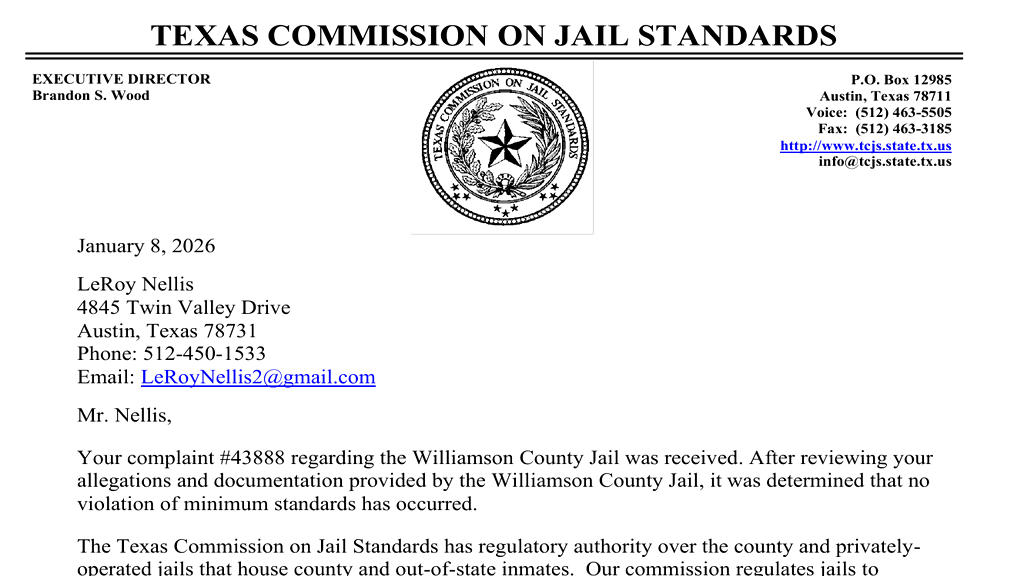
A letter from the Texas Commission on Jail Standards closed a complaint about the Williamson County Jail in Georgetown, Texas, by reviewing the jail's own paperwork. That paperwork describes 336 days in a cell, a restraint chair, and permanent blindness.
On January 8, 2026, the Texas Commission on Jail Standards answered a complaint about the Williamson County Jail in Georgetown, Texas, with a single finding. After reviewing the allegations and the documentation the jail itself provided, the Commission determined that no violation of minimum standards has occurred. The letter went to the complainant, LeRoy Nellis, and it addressed his allegations one at a time — confirming the central one: there are, the letter states, multiple refusals for medical services in the documents provided by Williamson County, and after multiple refusals the medical services will no longer be offered.
A finding, and what it was made of
The letter is dated January 8, 2026, and is signed from the office of Executive Director Brandon S. Wood of the Texas Commission on Jail Standards, which regulates county and privately-operated jails “to ensure that they are in compliance with minimum standards.” Complaint #43888 was received, and the documentation reviewed was provided by the Williamson County Jail.
On the medical question, the letter states: “The Texas Commission on Jail Standards does not question the professional opinion of medical personnel.” It advises anyone who believes the treatment was insufficient to raise it with the facility's medical staff and submit a sick call or request form.
On the remaining allegations, the letter records the jail's own response:
- Medication and unlicensed staff. “You allege medication is being issued by unlicensed staff. The jailers are designated by the sheriff/operator to do so,” and jailers follow jail procedures for distributing prescriptions in accordance with written instructions from a physician. - The restraint chair. “Submitted documentation shows you were placed in a restraint chair for your safety and appropriately monitored and seen by medical staff once taken out of the restraints.” - Solitary confinement. “You allege to be in solitary confinement for 326 days. Documentation provided shows that the transition to a single cell was done at your request.” The letter adds that staff determine how and where an inmate is housed under the classification process, and recommends directing concerns to the Sheriff or Jail Administrator.
It is signed by Sheriff Kelly Rowe as Chair, Sheriff Richard Kirkpatrick of Kingsville, and Commissioner Ben Perry of Waco.
What the record shows
The report Nellis prepared covering 2019 to the present, filed as a comprehensive evidentiary and legal analysis of the Williamson County Jail, documents the conditions the letter did not reach. It describes prolonged solitary confinement of roughly 336 days; sleep deprivation through continuous or strobe lighting; water shutoffs and sanitation deprivation; extreme temperatures; and the use of the restraint chair outside emergency necessity. Under Taylor v. Riojas (2020) and Bell v. Wolfish (1979), the report notes, courts evaluate conditions of confinement cumulatively.
On medicine, the report describes a chronic condition requiring continuous monitoring and care, and identifies delayed or denied medication, failure to monitor glucose levels, improper or forced injections, the lack of qualified medical oversight, and failure to respond to deterioration. It treats those failures as deliberate indifference under Estelle v. Gamble (1976) and Farmer v. Brennan (1994), and as an independent violation of the Americans with Disabilities Act. It also reports evidence that care was provided by an individual lacking a valid license through the Texas Medical Board during the relevant period.
The structure is the report's other subject: part-time physician coverage, reliance on contract providers, delegation to non-physician staff, and no continuous oversight — the elements of a municipal policy under Monell v. Department of Social Services (1978). On notice, the report cites repeated grievances, public records requests, and DOJ complaint filings.
“The facility policy advises after multiple refusals for the medical services they will no longer be offered.”
The injury, and the question left open
The report states the outcome plainly: the detainee suffered permanent blindness and neurological damage, and that the conditions and the injury are linked by foreseeability and the failure to intervene. Its conclusion is that qualified immunity protections are defeated on this record — clearly established rights violated, objectively unreasonable conduct, obvious constitutional violations, documented knowledge of risk, and no reasonable official could believe such conduct was lawful. Individual liability, municipal liability under Monell, federal enforcement under 34 U.S.C. § 12601, and ADA enforcement through DOJ are the exposures it identifies.
What the Commission's letter decides is narrower: whether the jail met the state's minimum standards, on the record the jail supplied. It does not decide whether the treatment was deliberately indifferent, whether the county is liable under Monell, whether the Americans with Disabilities Act was violated, or what becomes of the federal claims already filed.
What the Record Shows
Complaint #43888, filed over the Williamson County Jail in Georgetown, Texas, was answered on January 8, 2026, by the Texas Commission on Jail Standards: no violation of minimum standards has occurred. The state's own letter confirms multiple refusals for medical services in the county's documents, sets out the policy that services will no longer be offered after multiple refusals, records that medication is issued by jailers designated by the sheriff or operator, records the restraint chair, and answers the solitary-confinement allegation with 326 days — where the report's own record puts the confinement at roughly 336 days. The report filed with it documents prolonged isolation, unlicensed medical treatment, and permanent blindness.
The minimum-standards question was answered. The federal civil-rights questions were not.