
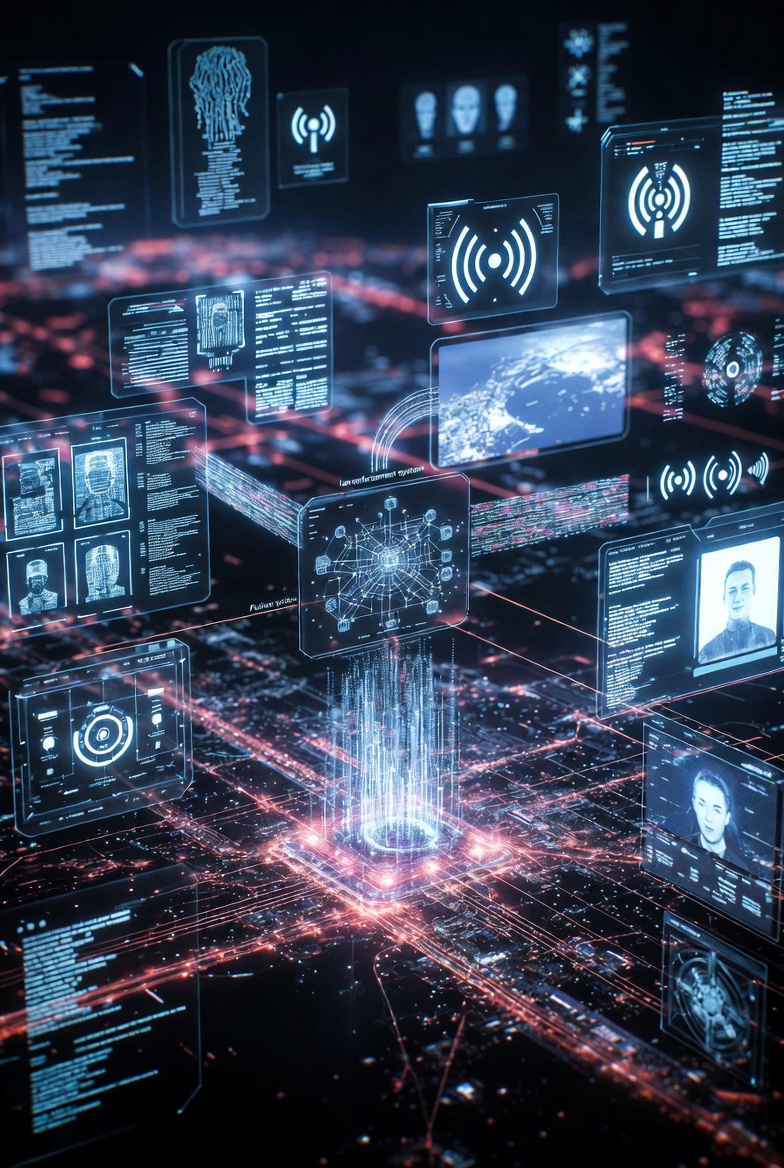


Law Enforcement Surveillance: Hidden Data Systems
Law enforcement surveillance now operates through a deeply integrated network of databases, telecommunications monitoring systems, and biometric tools that collect and analyze massive volumes of data in real time.
This infrastructure spans federal, state, and local agencies, forming a unified intelligence environment capable of reconstructing identity, movement, communication patterns, and behavioral profiles.
For related analysis, see the systemic detention timeline and the live evidentiary record.
For legal context, review Electronic Frontier Foundation and ACLU surveillance research.
Law Enforcement Surveillance Systems Overview
Modern surveillance systems no longer operate as isolated tools. They function as interconnected investigative networks where multiple data sources combine into a single analytical framework.
Each system captures fragments. Combined, they reconstruct full behavioral patterns.
Cell-Site Simulators (IMSI Catchers)
IMSI catchers mimic cellular towers, forcing nearby mobile devices to connect and reveal identifying signals such as IMSI and IMEI numbers.
- Device identification
- Signal triangulation
- Location tracking
- Network registration data
These tools are widely used for location tracking and device identification in modern investigations.
Telecommunications Metadata Systems
Pen register and trap-and-trace systems capture metadata rather than message content, including call logs, timestamps, and routing data.
- Call records
- Communication patterns
- Network routing paths
- Timestamp analysis
Large datasets of metadata can reveal detailed social networks and behavioral trends.
Mobile Device Forensics
Forensic tools extract stored data directly from seized devices, including messages, application data, files, and location history.
- Messages and call logs
- Application data
- Stored media
- Location history
Platforms such as Cellebrite and GrayKey are commonly used in digital forensic investigations.
License Plate Recognition (ALPR)
ALPR systems use cameras to capture and record vehicle movement across cities and highways.
- Plate numbers
- Date and time
- GPS location
- Vehicle imagery
Aggregated records create long-term movement histories of vehicles.
Facial Recognition Systems
Facial recognition compares images captured from cameras against databases of known individuals.
- Mugshot databases
- Driver license images
- Government ID records
These systems are typically used as investigative leads rather than final identification.
Data Fusion and Intelligence Networks
Fusion centers integrate data from multiple systems into unified intelligence platforms.
- Criminal records
- Vehicle data
- Telecommunications metadata
- Public safety systems
This integration forms the backbone of modern investigative infrastructure.
Conclusion — Surveillance as Infrastructure
Law enforcement surveillance is no longer reactive—it is continuous, predictive, and systemic.
The question is no longer whether surveillance exists, but how it is governed and who controls the data.