

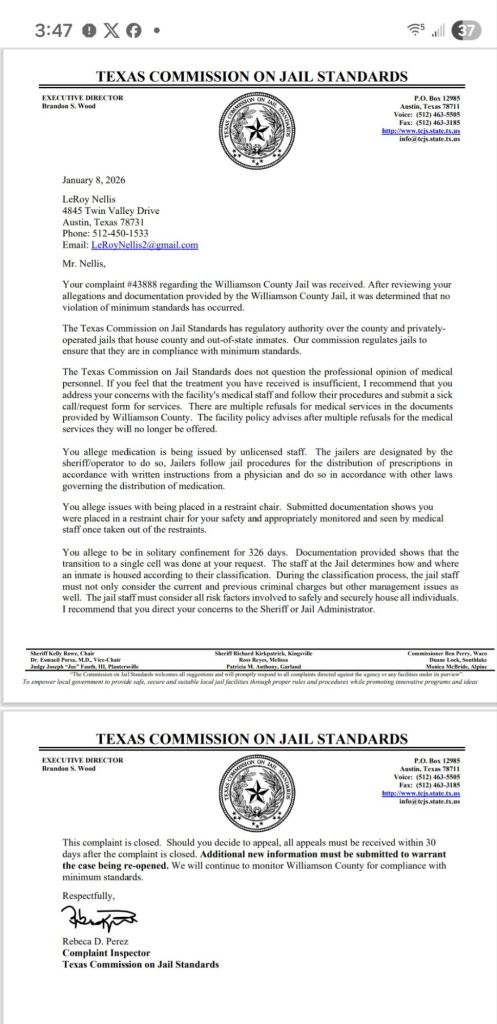
TCJS Complaint Appeal: Formal Response to Closure of Complaint #43888
TCJS complaint appeal documents the formal response to the Texas Commission on Jail Standards closure of Complaint #43888, outlining deficiencies in oversight, reliance on jail-provided records, and failure to independently investigate material allegations.
By LeRoy Nellis | Austin, Texas
For supporting evidence, see the systemic detention timeline and live evidentiary record.
For regulatory authority, review Texas Commission on Jail Standards and Fourteenth Amendment protections.
TCJS Complaint Appeal — Overview
This appeal challenges the January 8, 2026 closure of Complaint #43888. The purpose is to preserve the administrative record and document deficiencies in the Commission’s review process.
The appeal identifies systemic failures, including reliance on self-reported documentation, refusal to assess licensing compliance, and mischaracterization of critical facts.
Reliance on Jail-Supplied Documentation
The Commission relied exclusively on records provided by Williamson County Jail, without independent verification, witness interviews, or external review.
This creates a closed evidentiary loop in which allegations are evaluated solely by the accused party.
Medical Oversight and Licensing Issues
The Commission declined to assess whether medical actions complied with Texas licensing requirements.
- Medication administration by unlicensed personnel
- Delegation practices without regulatory review
- Failure to examine compliance with state law
This represents a failure of oversight, not deference to medical judgment.
Mischaracterization of Medical Refusals
Records citing “refusals” do not reflect coercive conditions or delayed care.
Checkbox documentation does not establish voluntary refusal in a custodial environment.
Solitary Confinement Misrepresentation
The claim that isolation occurred at my request is inaccurate.
Housing decisions were imposed unilaterally, without consent or independent review.
Restraint Chair Use Without Review
The Commission accepted assertions of safety without evaluating:
- Clinical necessity
- Alternative measures
- Duration and conditions of restraint
No supporting documentation or standards analysis was provided.
Unaddressed Allegations
- Environmental sleep deprivation
- Religious retaliation
- Grievance interference
- Record alteration or disappearance
- Attorney-client interference
These issues were not evaluated or addressed in the closure.
Procedural Deficiencies
The closure letter does not identify:
- Assigned investigators
- Witness interviews
- Independent inspections
- Applicable standards used
This constitutes administrative closure without factual findings.
Conclusion
TCJS complaint appeal demonstrates that oversight failed to meet basic investigative standards, resulting in closure without meaningful review.
This is not a disagreement over conclusions—it is a failure of process.