

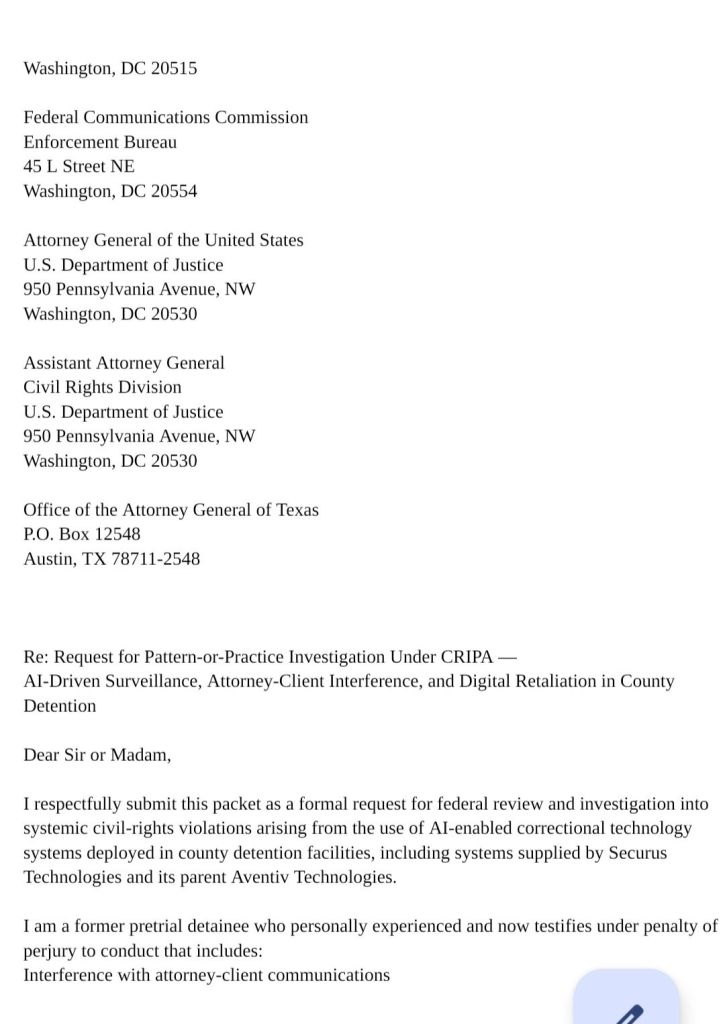

CRIPA Investigation Jail: Pattern-or-Practice Civil Rights Violations in County Detention
CRIPA investigation jail filings request federal review of systemic civil rights violations in detention facilities, including surveillance abuse, attorney-client interference, and retaliatory digital activity.
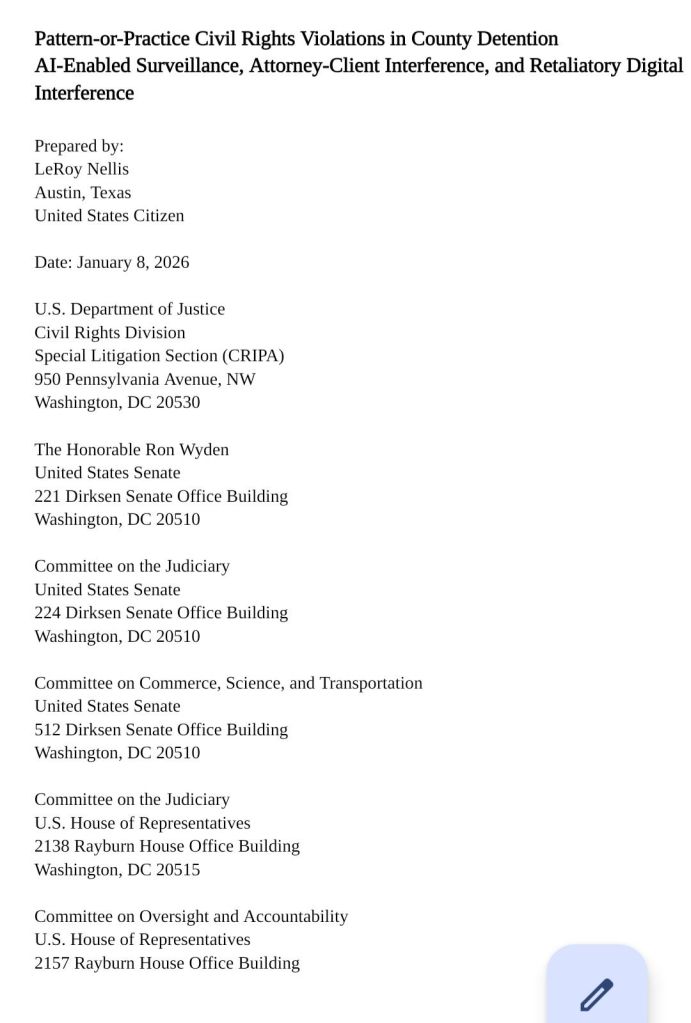
Prepared by:
LeRoy Nellis
Austin, Texas
For supporting evidence, see the detention timeline and live evidentiary record.
For federal legal authority, review CRIPA statute overview.
CRIPA Investigation Jail — Executive Summary
This packet documents pattern-or-practice civil-rights violations tied to AI-enabled correctional systems. These systems conduct continuous interception, behavioral analysis, and automated escalation.
A $3.7 million federal settlement has already confirmed unlawful recording of attorney-client communications. Despite this, the same architecture remains deployed.
Complainant Statement & Jurisdiction
I was a pretrial detainee entitled to full constitutional protections under the Sixth and Fourteenth Amendments.
Federal jurisdiction is invoked under CRIPA (42 U.S.C. § 1997).
Attorney-Client Interference
Communications were routed through systems later confirmed to have recorded privileged calls, creating a chilling effect on legal defense.
Digital Interference and Retaliation
Persistent interference with accounts and communications occurred in correlation with:
- Use of detention communication systems
- Legal filings and protected speech
- Documentation of jail conditions
The pattern impaired access to counsel and due process rights.
System Capabilities and Evidence
- Call interception
- Voice biometrics
- Behavioral inference
- Pattern-of-life tracking
- Cross-system data sharing
These are structural capabilities—not isolated failures.
Legal Violations
- Federal Wiretap Act
- Fourth Amendment
- Sixth Amendment
- Fourteenth Amendment
- 42 U.S.C. § 1983
Basis for CRIPA Review
- System-wide deployment
- Vendor-driven architecture
- Repeat violations across facilities
This meets the threshold for pattern-or-practice enforcement.
Requested Actions
- Open federal investigation
- Subpoena system logs and contracts
- Audit privilege protections
- Examine retaliation patterns
Conclusion
CRIPA investigation jail actions are necessary where systems function as designed yet violate constitutional protections.
This is not an isolated issue. It is systemic.
CRIPA Investigation Jail: Pattern-or-Practice Civil Rights Violations in County Detention
CRIPA investigation jail filings request federal review of systemic civil rights violations in detention facilities, including surveillance abuse, attorney-client interference, and retaliatory digital activity.
Prepared by:
LeRoy Nellis
Austin, Texas
For supporting evidence, see the detention timeline and live evidentiary record.
For federal legal authority, review CRIPA statute overview.
CRIPA Investigation Jail — Executive Summary
This packet documents pattern-or-practice civil-rights violations tied to AI-enabled correctional systems. These systems conduct continuous interception, behavioral analysis, and automated escalation.
A $3.7 million federal settlement has already confirmed unlawful recording of attorney-client communications. Despite this, the same architecture remains deployed.
Complainant Statement & Jurisdiction
I was a pretrial detainee entitled to full constitutional protections under the Sixth and Fourteenth Amendments.
Federal jurisdiction is invoked under CRIPA (42 U.S.C. § 1997).
Attorney-Client Interference
Communications were routed through systems later confirmed to have recorded privileged calls, creating a chilling effect on legal defense.
Digital Interference and Retaliation
Persistent interference with accounts and communications occurred in correlation with:
- Use of detention communication systems
- Legal filings and protected speech
- Documentation of jail conditions
The pattern impaired access to counsel and due process rights.
System Capabilities and Evidence
- Call interception
- Voice biometrics
- Behavioral inference
- Pattern-of-life tracking
- Cross-system data sharing
These are structural capabilities—not isolated failures.
Legal Violations
- Federal Wiretap Act
- Fourth Amendment
- Sixth Amendment
- Fourteenth Amendment
- 42 U.S.C. § 1983
Basis for CRIPA Review
- System-wide deployment
- Vendor-driven architecture
- Repeat violations across facilities
This meets the threshold for pattern-or-practice enforcement.
Requested Actions
- Open federal investigation
- Subpoena system logs and contracts
- Audit privilege protections
- Examine retaliation patterns
Conclusion
CRIPA investigation jail actions are necessary where systems function as designed yet violate constitutional protections.
This is not an isolated issue. It is systemic.
CRIPA Investigation Jail: Pattern-or-Practice Civil Rights Violations in County Detention
CRIPA investigation jail filings request federal review of systemic civil rights violations in detention facilities, including surveillance abuse, attorney-client interference, and retaliatory digital activity.
Prepared by:
LeRoy Nellis
Austin, Texas
For supporting evidence, see the detention timeline and live evidentiary record.
For federal legal authority, review CRIPA statute overview.
CRIPA Investigation Jail — Executive Summary
This packet documents pattern-or-practice civil-rights violations tied to AI-enabled correctional systems. These systems conduct continuous interception, behavioral analysis, and automated escalation.
A $3.7 million federal settlement has already confirmed unlawful recording of attorney-client communications. Despite this, the same architecture remains deployed.
Complainant Statement & Jurisdiction
I was a pretrial detainee entitled to full constitutional protections under the Sixth and Fourteenth Amendments.
Federal jurisdiction is invoked under CRIPA (42 U.S.C. § 1997).
Attorney-Client Interference
Communications were routed through systems later confirmed to have recorded privileged calls, creating a chilling effect on legal defense.
Digital Interference and Retaliation
Persistent interference with accounts and communications occurred in correlation with:
- Use of detention communication systems
- Legal filings and protected speech
- Documentation of jail conditions
The pattern impaired access to counsel and due process rights.
System Capabilities and Evidence
- Call interception
- Voice biometrics
- Behavioral inference
- Pattern-of-life tracking
- Cross-system data sharing
These are structural capabilities—not isolated failures.
Legal Violations
- Federal Wiretap Act
- Fourth Amendment
- Sixth Amendment
- Fourteenth Amendment
- 42 U.S.C. § 1983
Basis for CRIPA Review
- System-wide deployment
- Vendor-driven architecture
- Repeat violations across facilities
This meets the threshold for pattern-or-practice enforcement.
Requested Actions
- Open federal investigation
- Subpoena system logs and contracts
- Audit privilege protections
- Examine retaliation patterns
Conclusion
CRIPA investigation jail actions are necessary where systems function as designed yet violate constitutional protections.
This is not an isolated issue. It is systemic.