



Pattern-or-Practice Civil Rights Violations in County Detention
AI-Enabled Surveillance, Attorney-Client Interference, and Retaliatory Digital Interference
Prepared by:
LeRoy Nellis
Austin, Texas
United States Citizen
Date: January 8, 2026
U.S. Department of Justice
Civil Rights Division
Special Litigation Section (CRIPA)
950 Pennsylvania Avenue, NW
Washington, DC 20530
The Honorable Ron Wyden
United States Senate
221 Dirksen Senate Office Building
Washington, DC 20510
Committee on the Judiciary
United States Senate
224 Dirksen Senate Office Building
Washington, DC 20510
Committee on Commerce, Science, and Transportation
United States Senate
512 Dirksen Senate Office Building
Washington, DC 20510
Committee on the Judiciary
U.S. House of Representatives
2138 Rayburn House Office Building
Washington, DC 20515
Committee on Oversight and Accountability
U.S. House of Representatives
2157 Rayburn House Office Building
Washington, DC 20515
Federal Communications Commission
Enforcement Bureau
45 L Street NE
Washington, DC 20554
Attorney General of the United States
U.S. Department of Justice
950 Pennsylvania Avenue, NW
Washington, DC 20530
Assistant Attorney General
Civil Rights Division
U.S. Department of Justice
950 Pennsylvania Avenue, NW
Washington, DC 20530
Office of the Attorney General of Texas
P.O. Box 12548
Austin, TX 78711-2548
Re: Request for Pattern-or-Practice Investigation Under CRIPA — AI-Driven Surveillance, Attorney-Client Interference, and Digital Retaliation in County Detention
Dear Sir or Madam,
I respectfully submit this packet as a formal request for federal review and investigation into systemic civil-rights violations arising from the use of AI-enabled correctional technology systems deployed in county detention facilities, including systems supplied by Securus Technologies and its parent Aventiv Technologies.
I am a former pretrial detainee who personally experienced and now testifies under penalty of perjury to conduct that includes:
- Interference with attorney-client communications
- Mass surveillance exceeding constitutional and statutory limits
- Retaliatory and unexplained digital interference (“hacking-like events”) temporally linked to detention, protected speech, and legal activity
- Psychological coercion and deprivation of meaningful access to counsel
Independent of my testimony, federal settlements, state lawsuits, and congressional inquiries already establish that these systems have recorded and disseminated privileged attorney-client communications, in violation of federal law. The vendor-disclosed system architecture, as reflected in publicly issued patents, demonstrates that these violations are structural, not accidental.
I submit this packet for review by the Civil Rights of Institutionalized Persons Act (CRIPA) authority, and for congressional and regulatory oversight where appropriate.
Respectfully,
/s/ LeRoy Nellis
LeRoy Nellis
January 8, 2026
INDEX
- Executive Summary
- Complainant Statement & Jurisdiction
- Sworn Testimony of Observed Facts
- Systemic Evidence (Non-Testimonial)
- Legal Framework & Violations (Federal & State)
- Basis for CRIPA Pattern-or-Practice Jurisdiction
- Requested Government Actions
- Attestation
- Appendices
1. Executive Summary
This packet documents pattern-or-practice civil-rights violations associated with the deployment of AI-driven correctional communication and surveillance systems in county detention. These systems perform continuous interception, biometric analysis, behavioral inference, data federation, and automated escalation.
A $3.7 million federal settlement has already confirmed unlawful recording and disclosure of attorney-client communications by systems of this class. Despite that outcome, the same architecture remains deployed.
The violations described herein affect:
- Pretrial detainees
- Right to counsel
- Due process
- Privacy and freedom from retaliation
2. Complainant Statement & Jurisdiction
I was a pretrial detainee housed in a county detention facility utilizing AI-enabled correctional communication systems.
I was not convicted at the time of the conduct described.
I was entitled to full Sixth and Fourteenth Amendment protections.
DOJ jurisdiction is invoked under CRIPA, 42 U.S.C. § 1997, and related civil-rights statutes.
3. Sworn Testimony of Observed Facts
A. Attorney-Client Interference
Attorney communications were routed through systems later confirmed by federal settlement to have recorded privileged calls.
No reliable or transparent mechanism ensured confidentiality.
This created a chilling effect on my ability to communicate freely with counsel.
B. Digital Interference & Retaliation
During and after detention, I experienced persistent, unexplained interference with digital accounts and communications.
These events correlated in time with:
- Use of detention communication systems
- Legal filings, complaints, and protected speech
- Attempts to document detention conditions
The interference included:
- Loss of access to accounts
- Altered or blocked communications
- Apparent monitoring behaviors inconsistent with civilian norms
I do not claim technical certainty as to the mechanism. I do testify that the pattern, timing, and persistence of these events materially impaired my ability to communicate, prepare legal defenses, and exercise protected rights.
4. Systemic Evidence (Non-Testimonial)
A. Confirmed Federal Outcome
Federal class settlement ($3.7 million) resolving claims of unlawful recording and disclosure of attorney-client calls.
B. Vendor-Disclosed Capabilities (Public Record)
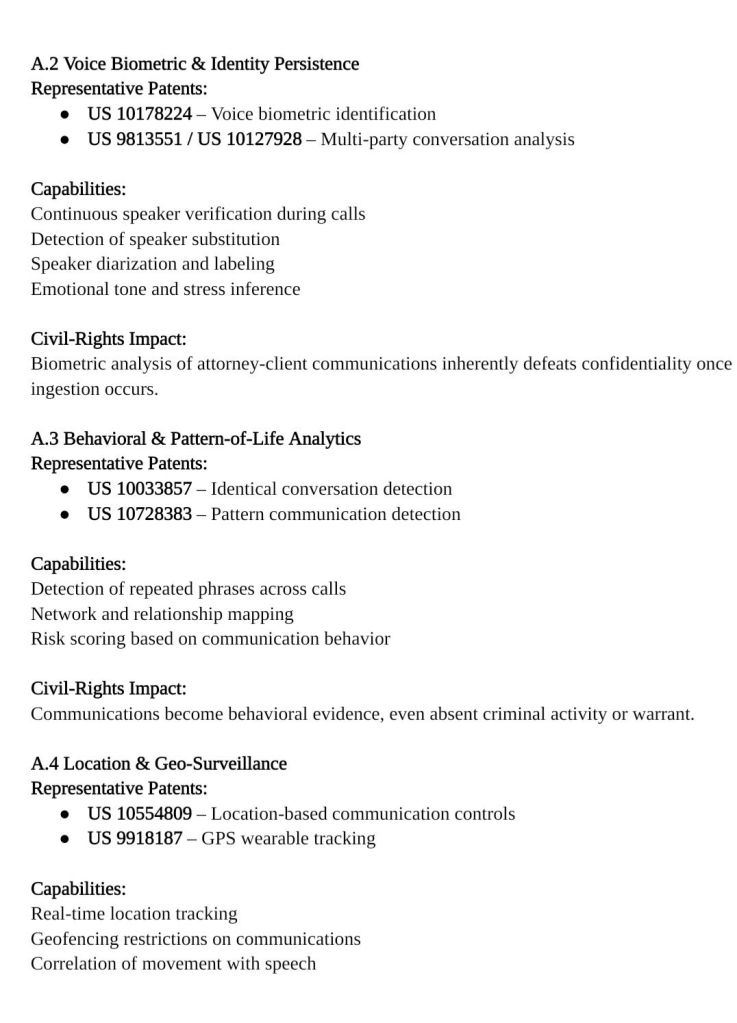
Patents and technical disclosures describe systems capable of:
- Continuous call interception
- Voice biometric identification
- Emotional and behavioral inference
- Pattern-of-life analysis
- Cross-facility data federation
- Automated escalation and access restriction
Once ingested, privileged data cannot be selectively “un-known.”
5. Legal Framework & Violations
- Federal Wiretap Act (18 U.S.C. § 2511)
- ECPA / Stored Communications Act
- Fourth Amendment
- Sixth Amendment
- Fourteenth Amendment
- CALEA
- TCPA
- State wiretap statutes
- Attorney-client privilege
- 42 U.S.C. § 1983
6. Basis for CRIPA Pattern-or-Practice Review
- Vendor-designed
- Contract-mandated
- Facility-wide
- AI-automated
- Repeated across jurisdictions
CRIPA exists to address systems that function as designed yet violate rights as deployed.
7. Requested Government Actions
- Open a CRIPA pattern-or-practice investigation
- Subpoena vendor-county contracts and system logs
- Audit attorney-client privilege protections
- Examine retaliation against detainees
- Refer findings for enforcement
8. Attestation
I declare under penalty of perjury that the foregoing is true and correct to the best of my knowledge and belief.
/s/ LeRoy Nellis
LeRoy Nellis
January 8, 2026
 LeRoy Nellis