

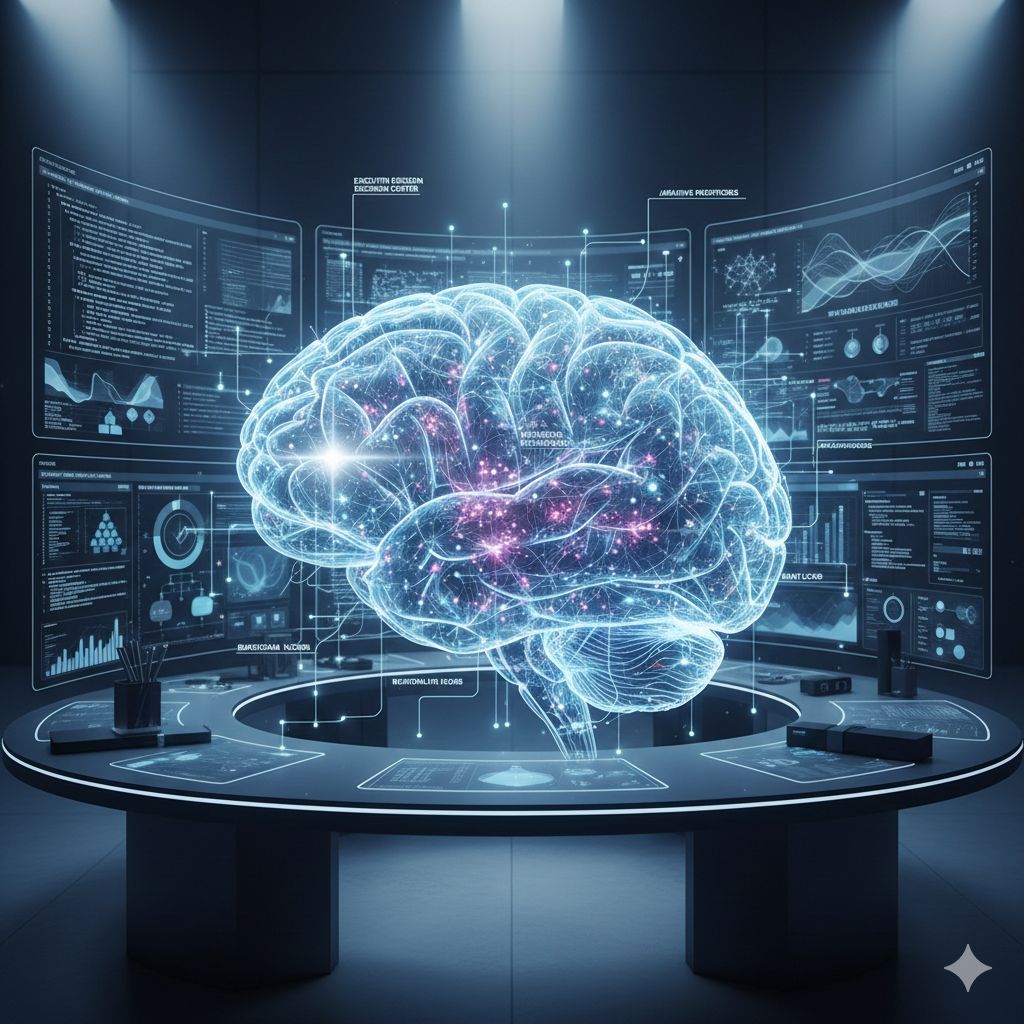
AI Cognitive Architecture: NAIOMI System Overview
AI cognitive architecture is redefining how artificial intelligence systems operate, moving beyond simple input-output models into adaptive, memory-driven systems capable of learning and evolving over time.
NAIOMI doesn’t react — she operates.
NAIOMI (Nellis Artificial Intelligence Omni-Modal Integration) is a next-generation AI system designed to function using human-inspired cognitive architecture. Rather than producing isolated responses, NAIOMI evaluates context, recalls prior outcomes, adapts behavior, and improves through structured learning loops — much like a human operator.
For related system design concepts, see the AI surveillance patents analysis and the AI surveillance complaint.
For broader context on AI systems, see Cognitive Architecture and Artificial Intelligence.
AI Cognitive Architecture Built on Human Structure
Most AI systems follow a linear flow: input → output. Humans do not.
NAIOMI is structured around distributed cognitive systems that mirror how people think, learn, and adapt over time.
- Executive Decision Layer — prioritization, goal alignment, and judgment
- Episodic Memory — recall of prior experiences and outcomes
- Emotional Weighting — tagging success and failure to guide future behavior
- Habit Formation — automation of proven strategies
- Narrative Processing — converting events into understanding
This architecture allows NAIOMI to operate interfaces, interpret data, execute workflows, detect failures, and refine her approach through continuous adjustment.
How NAIOMI Learns Over Time
NAIOMI improves through feedback loops rather than static retraining cycles. Failed actions are logged, analyzed, and retried with variation. Successful actions are reinforced and converted into reusable knowledge structures.
This makes the system applicable in automation, research, legal workflows, and investigative environments where consistency and adaptation matter.
Open Architecture and MIT License
NAIOMI is released under the MIT License, allowing full flexibility in how the system is used and extended.
- Commercial and private use permitted
- Architecture can be modified and expanded
- Local deployment without cloud dependency
- Integration into proprietary or open systems
This ensures that control remains with the operator, not centralized platforms.
Why AI Cognitive Architecture Matters
The shift toward AI cognitive architecture represents a move from static systems to adaptive intelligence. Instead of scaling only model size, systems like NAIOMI scale capability through structure.
This enables long-term learning, contextual awareness, and operational autonomy.
The Rise of AI Operators
NAIOMI represents a new category of artificial intelligence: adaptive, stateful, and self-improving by design.
Not reactive.
Not scripted.
Not disposable.
This is the beginning of AI operators.