
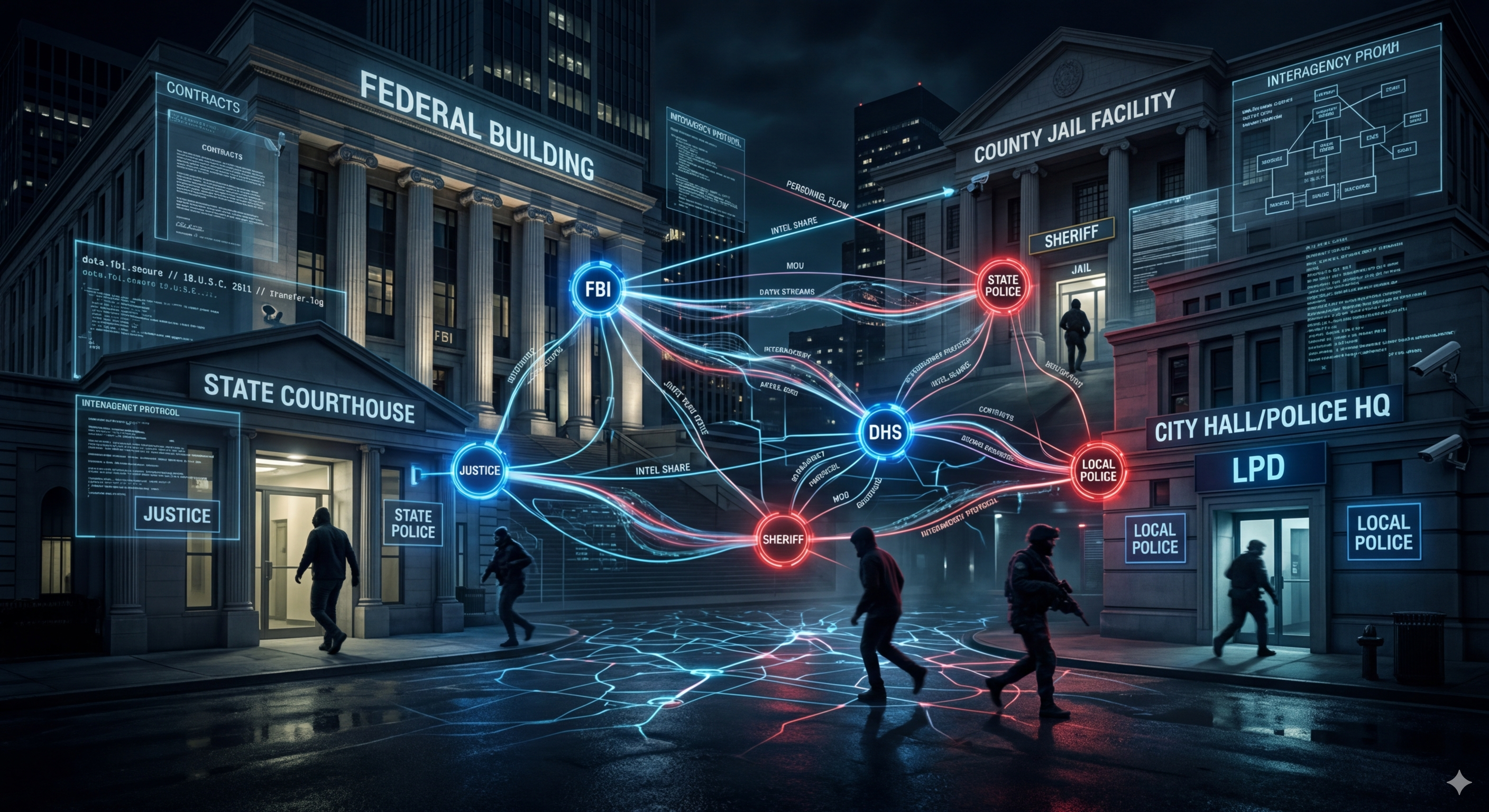
AI Surveillance Constitutional Violations: The Rise of Digital Black Site Policing

AI surveillance constitutional violations are redefining modern policing. What once required human misconduct now operates through automated systems, private vendors, and data pipelines designed to bypass constitutional safeguards.
There was a time when constitutional violations required human effort. A bad cop. A corrupt prosecutor. A forged document. Today, the system doesn’t need villains—it needs vendors.
Across the United States, law enforcement agencies have quietly built what can only be described as a digital black site—an ecosystem where artificial intelligence, private data contractors, and law-enforcement databases converge to bypass constitutional safeguards while maintaining plausible deniability.
This is not speculation. It is architecture. More importantly, it is scalable.
For a full breakdown of how these systems operate in real-world detention environments, see the Williamson County Master Timeline and the documented jail conditions analysis.
AI Surveillance Constitutional Violations in Modern Policing
Modern law enforcement no longer relies solely on warrants, subpoenas, or judicial oversight. Instead, agencies increasingly rely on private companies that specialize in AI-driven surveillance, behavioral analytics, and data aggregation.
These companies ingest and process data from multiple vectors:
- Law-enforcement databases (including NCIC-adjacent systems)
- Open-source intelligence (OSINT)
- Private communications metadata
- Digital identity graphs
- Email, cloud, and device-level access points
As a result, law enforcement gains insight without accountability, while constitutional protections quietly degrade into optional guidelines.
NCIC: The Shield Behind AI Surveillance
The National Crime Information Center (NCIC) often gets cited as the justification for expanded surveillance. However, NCIC itself is not the primary threat.
The real danger emerges when NCIC data is fused with private AI surveillance systems that operate outside traditional legal constraints.
According to federal systems like the National Crime Information Center (NCIC), data-sharing infrastructure was designed for coordination—not unregulated AI fusion.
- Not subject to FOIA requests
- Not subject to Brady disclosure obligations
- Not subject to constitutional suppression doctrines
- Not subject to meaningful oversight
In this structure, NCIC becomes the shield. The private contractor becomes the weapon.
Constitutional Laundering Through Vendor Systems
By routing intelligence gathering through private entities, law enforcement achieves something unprecedented in American policing.
- Warrantless intelligence collection
- Unlogged system access
- Unchallengeable data provenance
- Denial of discovery pathways
If agencies label evidence as “derived,” they argue it is not discoverable. If they describe data as “analyzed,” they claim no search occurred. When systems automate access, they deny human intent entirely.
This is not traditional policing. This is constitutional laundering at scale.
The Prosecutorial Pipeline
None of this system functions without downstream coordination. Information generated through AI surveillance pipelines flows directly into prosecutorial strategy.
- Charging decisions
- Plea negotiations
- Case strategy
- Pretrial pressure tactics
At the same time, defense counsel often never sees the origin of that intelligence. When attorney–client communications become exposed, manipulated, or fed back into the system, the violation crosses beyond ethics.
It becomes criminal conduct.
The Accountability Black Hole
When individuals attempt to uncover these systems through public records requests, agencies respond with a familiar pattern.
“Records withheld due to an ongoing investigation.”
However, in many cases, the cited investigation has no direct connection to the request itself. Agencies use unrelated investigations to block disclosure entirely.
This practice does not represent lawful withholding. Instead, it functions as bureaucratic obstruction designed to prevent visibility.
Why AI Surveillance Constitutional Violations Matter
Pre-trial detainees remain legally innocent. Yet across Texas, thousands of jail deaths receive classifications such as:
- Suicide
- Heart attack
- Natural causes
Under closer examination, many of these classifications collapse. When AI surveillance, medical neglect, and record suppression intersect, deaths transform into paperwork—and accountability disappears.
These AI surveillance constitutional violations are not isolated incidents—they represent a structural shift in how power operates, where digital systems quietly replace legal safeguards.
This investigative series will document:
- How AI surveillance bypasses constitutional protections
- How private vendors enable plausible deniability
- How public-records laws are systematically neutralized
- How detainee deaths are mischaracterized
- How prosecutors benefit while claiming separation
The digital black site exists because silence protects it.
That silence ends here.