
Texas County Jails and the Hidden System of Pre-Trial Torture
By LeRoy Nellis
Austin, Texas
What’s happening inside Texas county jails is not a series of isolated abuses.
It is a system.
Over the past two decades, Texas county jails have quietly transformed from short-term holding facilities into coercive pressure chambers for people who have not been convicted of any crime. Court records, state audits, federal investigations, and detainee testimony point to a consistent pattern: pre-trial detention is being weaponized to break defendants physically and psychologically before trial.1
This is not about isolated neglect. It is about design.
A Body Count Hidden in Plain Sight
Since the early 2000s, more than 8,400 pre-trial detainees have died in Texas county jails.2 Most deaths are officially attributed to “natural causes,” vague medical events, or preexisting conditions. Independent autopsies are rare, and long-term toxic exposure is almost never examined.3
Texas does not require routine hair toxicology, a forensic method capable of detecting chronic poisoning, medication manipulation, or prolonged biological stress. Blood tests—commonly relied upon instead—often miss these conditions entirely.4
The result is a structural forensic blind spot that minimizes custodial harm.
Environmental Torture: Black Mold as a Weapon
Multiple Texas county jails have documented infestations of black mold in housing units, showers, and ventilation systems.5 Detainees report chronic respiratory illness, neurological symptoms, migraines, immune dysfunction, and psychological deterioration consistent with prolonged mold exposure.6
Rather than relocating detainees or conducting environmental testing, complaints are frequently dismissed or reframed as mental illness or malingering.7
When officials knowingly confine people in toxic environments without remediation, courts have recognized this as deliberate indifference.8 International human-rights standards classify forced exposure to environmental toxins as inhuman and degrading treatment.9
Environmental Variables and Sanitation Deprivation
Detainees report cells where toilets were deliberately shut off for extended periods, leaving no functioning sanitation. In these conditions, individuals were forced to place human waste onto empty food trays and slide them outside the cell to be removed at staff discretion.10
This practice combines humiliation, biohazard exposure, and psychological degradation. Courts have held that intentional denial of sanitation constitutes unconstitutional conditions of confinement, and international standards recognize forced exposure to human waste as inhuman treatment.11–12
HVAC Manipulation and Weaponized Odor Exposure
Detainees report the use of ventilation systems as tools of coercion, forcing outside air—alternating extreme heat and cold—into cells regardless of weather or health impact.13
While a detainee’s toilet remains disabled, the adjacent cell’s toilet is kept operational for other inmates. Ventilation fans are then reversed, piping foul air from the neighboring cell directly into the detainee’s living space.14
This constitutes intentional sensory assault and environmental humiliation. Courts have recognized that exposure to extreme temperatures and noxious odors can violate constitutional standards, and international law prohibits environmental manipulation as coercive punishment.15–16
Food as Degradation: When Jail Meals Become Punishment
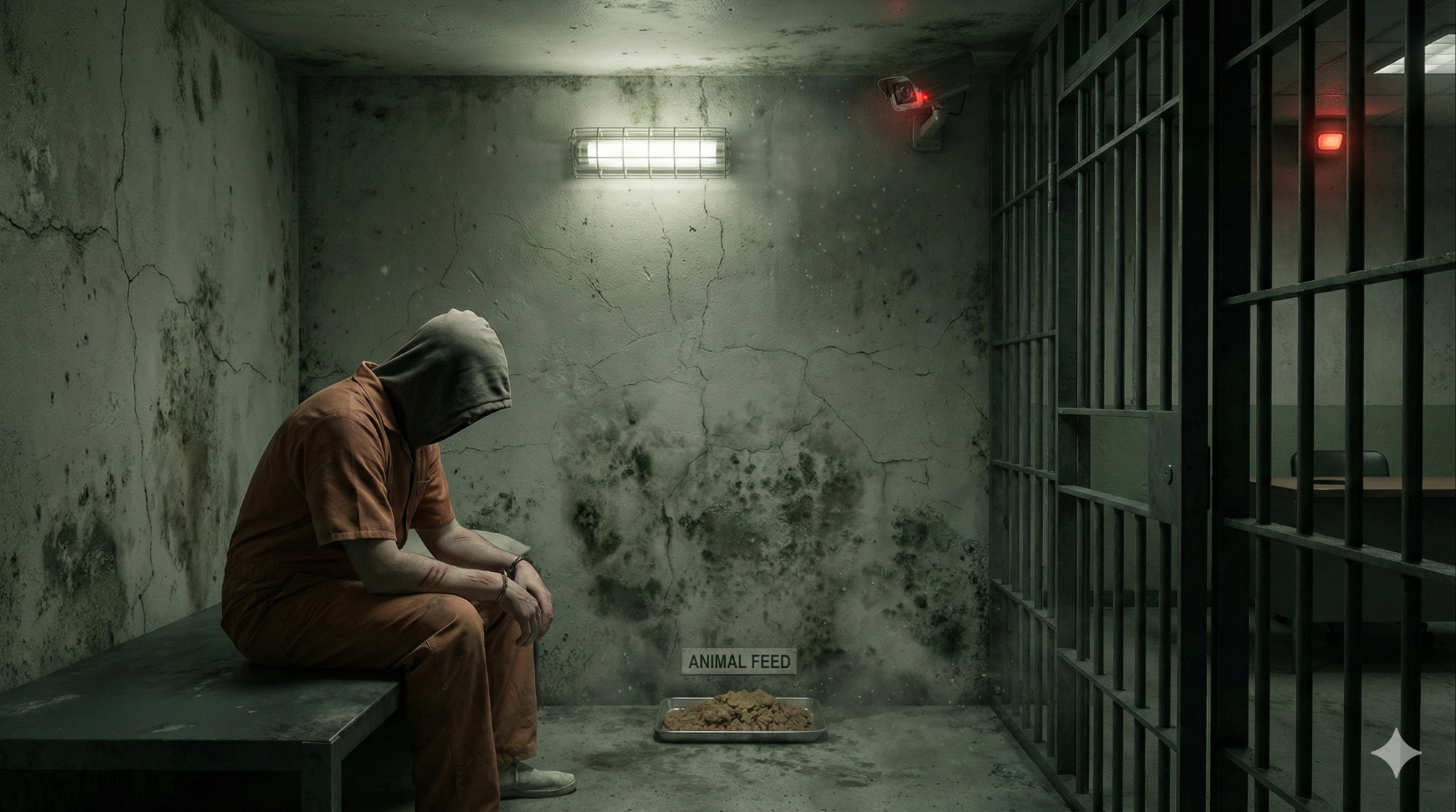
Detainees across Texas counties report being served spoiled food, nutritionally inadequate meals, or food not fit for human consumption, including products labeled for animal use such as dog food.17
- Physical weakening
- Psychological humiliation
- Reinforcement of subhuman status
Courts have consistently ruled that denial of adequate nutrition violates constitutional standards.18 International law further recognizes humiliation through food deprivation as cruel and inhuman treatment.19
Medical Abuse Without Leaving a Mark
Medical mistreatment in Texas jails is rarely overt. It is bureaucratic. Documented patterns include delayed treatment, withheld insulin, unlicensed medical staff, ignored environmental illness, and altered or incomplete medical records.20
For detainees with diabetes or chronic illness, these practices can trigger fatal complications later classified as “natural causes.”21 Legally, this meets the standard for deliberate indifference.22
Restraints, Shock, and Threat Simulation
Texas counties continue to use restraint chairs without proper medical oversight.23 Detainees report the threatened or actual use of conducted electrical weapons, including shock-capable gloves.24
Other reported practices include laser targeting inside dark cells, a documented threat-simulation technique associated with long-term psychological harm.25
Psychological Evaluations After the Damage Is Done
Psychological evaluations are ordered only after prolonged exposure to coercive conditions. Trauma-induced symptoms are then cited as evidence of instability, creating a closed loop: coercive detention → breakdown → loss of rights.26–28
Forced Exile Without Conviction
Approximately 1,400 pre-trial detainees have been transferred out of state, severing access to counsel and family while cases remain legally in Texas.29–31
Conclusion
This is not about bad actors. It is about infrastructure. Until independent autopsies, environmental testing, transparency in psychological evaluations, limits on out-of-state transfers, and federal investigations are imposed, the system will continue to function exactly as designed.32–33
And the paperwork will keep calling it “natural.”
Footnotes
- DOJ Civil Rights Division, CRIPA investigations; Texas State Auditor reports.
- Texas Justice Initiative, statewide custodial death datasets (2000–2024).
- Texas Commission on Jail Standards custodial death reports; county medical examiner summaries.
- National Association of Medical Examiners; forensic toxicology standards (hair vs. blood).
- State jail inspection reports; civil complaints citing mold exposure.
- CDC and NIH literature on mold-related illness.
- Detainee grievances; mental-health reclassification practices.
- Federal conditions-of-confinement case law under §1983.
- UN Convention Against Torture; Nelson Mandela Rules.
- Detainee affidavits describing toilet shut-offs and waste handling.
- Fourteenth Amendment sanitation jurisprudence.
- UN standards on forced exposure to human waste.
- Detainee affidavits describing HVAC manipulation.
- Ventilation system misuse and odor exposure complaints.
- Federal odor and temperature exposure case law.
- UN prohibitions on environmental coercion.
- Detainee affidavits; jail food-service contractor records.
- Eighth and Fourteenth Amendment food adequacy cases.
- UN Special Rapporteur on Torture findings.
- State audits; §1983 medical neglect litigation.
- American Diabetes Association correctional health guidance.
- Estelle v. Gamble, 429 U.S. 97 (1976).
- DOJ findings on restraint-chair misuse.
- ACLU reports on conducted electrical weapons.
- Psychological warfare and interrogation literature.
- Defense affidavits; court-ordered psych evaluation timelines.
- Forensic psychiatry research on trauma-induced symptoms.
- Due-process analyses of coerced psychological findings.
- Texas county transfer records.
- Sixth Amendment right-to-counsel analyses.
- UN findings on forced displacement.
- Pretrial Justice Institute research.
- DOJ pattern-or-practice authority under 34 U.S.C. §12601.
 LeRoy Nellis