
The Appendix A was changed this morning not to include the section of A. ALLEGATIONS ADDRESSED BY TCJS — RESPONSE DEFICIENT..I changed it back to the origional.. (January 9, 2026 @ 11:38 am)
VIA CERTIFIED MAIL AND EMAIL
Texas Commission on Jail Standards
Attn: Executive Director Brandon S. Wood
P.O. Box 12985
Austin, Texas 78711
Office of the Attorney General
P.O. Box 12548
Austin, TX 78711-2548
Texas Attorney General
U.S. Department of Justice
Civil Rights Division
950 Pennsylvania Avenue, N.W.
Office of the Assistant Attorney General, Main
Washington, D.C. 20530
Department of Justice
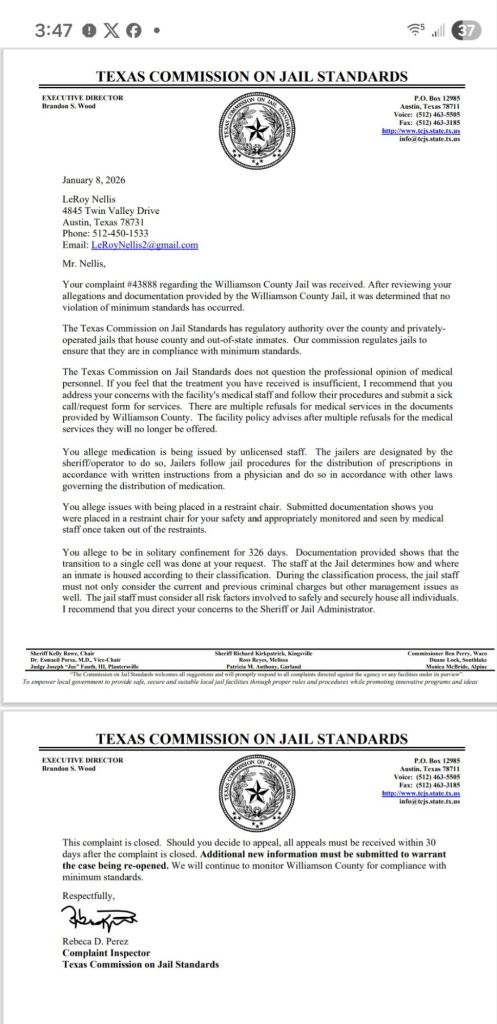
Re: Formal Appeal and Response to Closure of Complaint #43888
Complainant: LeRoy William Nellis II
Facility: Williamson County Jail
TCJS Closure Letter Dated: January 8, 2026
Dear Executive Director Wood and Members of the Commission,
I am submitting this letter as a formal appeal and response to the Texas Commission on Jail Standards’ January 8, 2026 closure of Complaint #43888. This response is submitted within the 30-day appeal window and is intended to preserve the record and submit additional clarification and information warranting reconsideration.
This appeal is not submitted to debate conclusions, but to document material deficiencies in the Commission’s review, including reliance on self-reported jail records, refusal to assess licensing compliance, and mischaracterization of key facts.
I. RELIANCE SOLELY ON ACCUSED PARTY’S DOCUMENTATION
The Commission’s determination appears to rely exclusively on documentation supplied by Williamson County Jail, the very entity accused of misconduct.
At no point was I interviewed, no independent witness statements were obtained, and no external verification was conducted. This methodology inherently defeats the purpose of regulatory oversight and creates a closed evidentiary loop in which allegations are evaluated solely by the accused party.
This is particularly concerning given the seriousness of the allegations raised, including prolonged isolation, restraint usage, and medical administration practices.
II. MEDICAL OVERSIGHT AND LICENSING ISSUES WERE NOT REVIEWED
The closure letter states:
“The Texas Commission on Jail Standards does not question the professional opinion of medical personnel.”
My complaint did not ask TCJS to substitute medical judgment. It raised regulatory and legal questions regarding:
- Whether medications were administered by unlicensed personnel,
- Whether delegation of medication distribution complied with applicable Texas law, and
- Whether jail policies permitted practices that exceed statutory authority.
Declining to assess licensing compliance is not deference — it is abdication of oversight. TCJS has authority over jail operations and procedures, including whether practices comply with minimum standards and applicable law. This issue was not substantively reviewed.
III. MISCHARACTERIZATION OF “REFUSALS” FOR MEDICAL SERVICES
The Commission’s letter references “multiple refusals for medical services” and suggests cessation of care was policy-based.
This characterization is incomplete and misleading.
Refusals reflected in jail records do not capture:
- Coercive conditions under which care was offered,
- Situations where requests were ignored or delayed until refusal was recorded,
- Or instances where care was conditioned on compliance or housing concessions.
The presence of a checkbox or form entry does not equate to informed, voluntary refusal, particularly in a custodial environment.
IV. SOLITARY CONFINEMENT WAS NOT “AT MY REQUEST”
The statement that my placement in a single cell was “done at my request” is inaccurate.
I did not request prolonged isolation, nor did I consent to extended single-cell confinement as imposed. Housing decisions were made unilaterally by jail staff, and any alleged “request” has been mischaracterized to justify conditions that amounted to long-term isolation.
This distinction is material and was not independently examined.
V. RESTRAINT CHAIR USE REQUIRES HEIGHTENED SCRUTINY
The Commission accepted jail documentation asserting restraint chair use was “for safety” and appropriately monitored.
However, the issue raised was not merely whether monitoring occurred, but whether:
- Use was clinically and procedurally justified,
- Less restrictive alternatives were considered, and
- Restraints were employed as a behavioral or compliance tool.
These factors were not analyzed.
VI. REQUEST FOR RECONSIDERATION OR RECORD PRESERVATION
Based on the above, I respectfully request that TCJS:
- Reconsider the closure of Complaint #43888 in light of the issues outlined herein; or
- In the alternative, formally acknowledge that:
- TCJS relied solely on jail-supplied documentation,
- TCJS declined to assess licensing and unlicensed practice concerns, and
- TCJS did not conduct independent factual development.
This clarification is necessary for the integrity of the record.
VII. PRESERVATION OF RIGHTS
Nothing in this response should be construed as a waiver of any rights or remedies available to me under state or federal law. This appeal is submitted to preserve administrative remedies and document oversight limitations.
Please confirm receipt of this appeal and advise whether the Commission intends to reopen the matter or maintain closure.
Respectfully submitted,
/s/ LeRoy William Nellis II
LeRoy William Nellis II
4845 Twin Valley Drive
Austin, Texas 78731
Phone: (512) 450-1533
Email: LeRoyNellis2@gmail.com
Date: January 8, 2026
APPENDIX A
DEFICIENCY MATRIX — MATERIAL ALLEGATIONS VS. TCJS FINDINGS
Complaint #43888 — Williamson County Jail
TCJS Closure Letter Dated: January 8, 2026
This Deficiency Matrix is submitted as an addendum to the foregoing appeal to document which material allegations were not addressed, and which were addressed in a conclusory or procedurally deficient manner, without identification of evidence reviewed or minimum jail standards applied.
This matrix is not submitted to relitigate conclusions, but to preserve the administrative record.
A. ALLEGATIONS ADDRESSED BY TCJS — RESPONSE DEFICIENT
Medication administered by unlicensed personnel
TCJS states jailers are designated and follow physician instructions
No verification of licensure; no identification of prescriber; no review of MARs; no citation to applicable minimum standards or Texas licensing law
Medical care complaints generally
TCJS declines to “question professional medical opinion”
Complaint raised regulatory compliance issues, not medical judgment; TCJS declined to assess licensing, delegation, or continuity of care
Restraint chair use
TCJS accepts jail assertion that use was for safety and appropriately monitored
No restraint logs cited; no medical clearance documentation identified; no analysis of necessity, alternatives, or duration; no standards cited
326 days of solitary confinement
TCJS states placement was at complainant’s request and classification-based
Disputed fact; no classification file reviewed; no segregation logs cited; no independent verification; no minimum standards analysis
B. MATERIAL ALLEGATIONS NOT ADDRESSED BY TCJS
- Structural or environmental vibration transmitted through cell flooring causing sleep deprivation and physical distress
- Environmental sleep deprivation (noise, vibration, lighting patterns)
- Religious retaliation (confiscation of Bible / punishment for religious exercise)
- Interference with or destruction of inmate grievances
- Retaliation following complaints to TCJS or other authorities
- Record falsification, backdating, or disappearance of documentation
- Coercive use of suicide watch or mental-health threats
- Attorney-client communication interference
- Inspection or testing of physical plant conditions
C. PROCEDURAL DEFICIENCIES IN TCJS REVIEW
The January 8, 2026 closure letter does not identify:
- The investigator(s) assigned to the complaint
- Any witnesses interviewed (including the complainant)
- Any independent inspection conducted
- Any records reviewed beyond jail-supplied documentation
- Any specific Texas Commission on Jail Standards rules applied
- Any factual findings tied to minimum jail standards
A determination issued without these elements constitutes an administrative closure without findings, rather than a documented regulatory investigation.
D. RECORD PRESERVATION STATEMENT
This Deficiency Matrix is submitted to preserve the record regarding the scope and limitations of the Commission’s review and to document material allegations that were not addressed or were resolved without articulated findings.
End of Appendix A
 LeRoy Nellis