
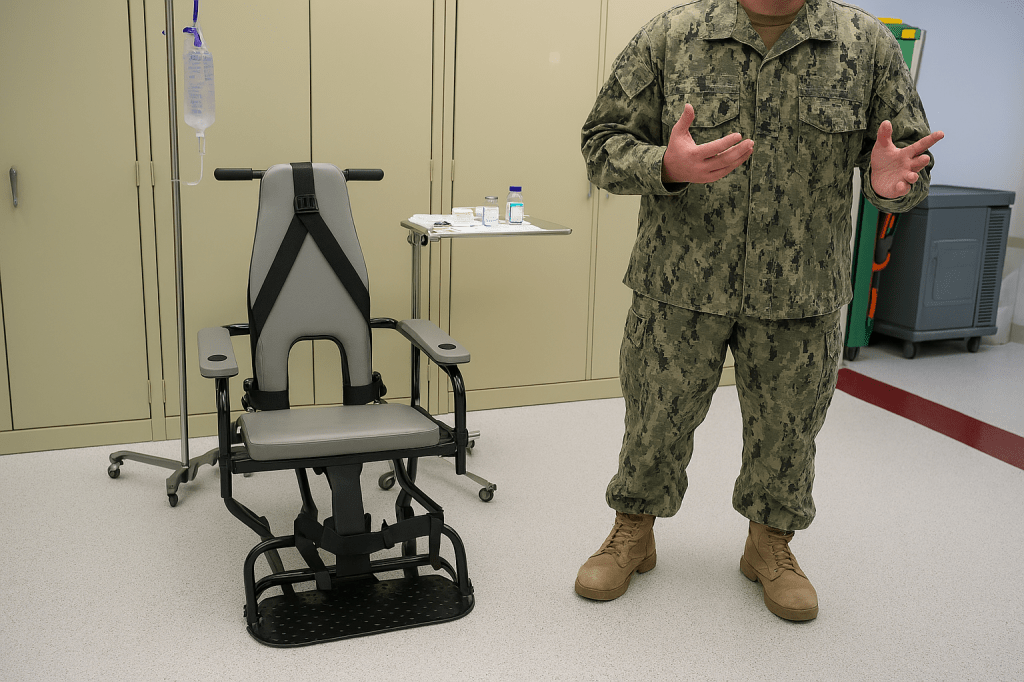
🧱 Scene: The Procession
I had passed an independent psychological exam just two weeks earlier. Cleared. Stable. Fit to engage. But inside Williamson County Jail, that meant nothing. Because if they can’t make you crazy, they’ll drive you crazy. That’s the logic. That’s the ritual.
I was on the fourth floor, wearing a smok—a suicide prevention garment designed to strip away identity under the guise of safety. No shoelaces. No dignity. Just fabric and surveillance.
Then came the chair.
It wasn’t stationary. It had wheels. They could move it anywhere, and they did. They strapped me in—wrists cinched, circulation fading—and began the procession. Down the hallway. Past cells. Past guards. Past people who looked away. I was paraded through the jail like a warning, like a spectacle, like a body that needed to be seen but not heard.
They wheeled me from the fourth floor down to intake. Not for processing. Not for care. Just to leave me there. Two and a half hours. Immobilized. Hands turning purple. No explanation. No medical check. No legal justification.
I wasn’t violent. I wasn’t unstable. I wasn’t resisting. I was simply trying to hold onto my religious materials—a Bible and a prayer rug. That was my crime. That was my rebellion. That was enough to warrant restraint, humiliation, and the slow collapse of blood flow in my hands.
The chair wasn’t just a tool. It was a ritual. A mobile altar of punishment. And every wheel that turned beneath me was a reminder: in Williamson County, policy replaces the Constitution. Mobility replaces accountability. And silence replaces justice.
⚠️ Systemic Harm in Williamson County Jail
🧠 Psychiatric Neglect as Psychological Torture
- Inmates deemed incompetent to stand trial have waited up to 618 days for psychiatric care.
- During this time, many deteriorate mentally, sometimes beyond recovery. Sheriff Gleason admitted, “They get worse and worse and worse”.
- This delay isn’t passive—it’s structurally enforced. The lack of timely treatment can lead to permanent cognitive damage, which some experts equate to psychological torture through abandonment.
🚨 Isolation and Sensory Deprivation
- While not explicitly called solitary confinement, the jail’s pod system includes constant surveillance, limited interaction, and minimal stimulation.
- These conditions—especially for mentally ill detainees—can mimic the effects of solitary: hallucinations, emotional collapse, and identity erosion.
🧪 Competency Restoration Inside Jail Walls
- Williamson County launched a jail-based competency restoration program to address the backlog.
- While it’s framed as reform, critics argue it’s a band-aid over a deeper wound: the jail itself remains a site of prolonged suffering, and restoration efforts may still occur under punitive conditions.
🧬 Historical Context of Misconduct
- The county has a legacy of prosecutorial abuse, most notably in the Michael Morton case, where evidence was deliberately withheld, leading to a wrongful conviction and 24 years of imprisonment.
- This culture of institutional indifference to truth and mental health amplifies the harm done inside the jail.
🔍 Why It Matters
What’s happening in Williamson County Jail may not involve overt physical torture devices—but the combination of psychiatric neglect, prolonged isolation, and systemic delay creates conditions that many legal scholars and human rights advocates would classify as inhumane treatment.
google-site-verification: google76036a55c413189b.html
 LeRoy Nellis