
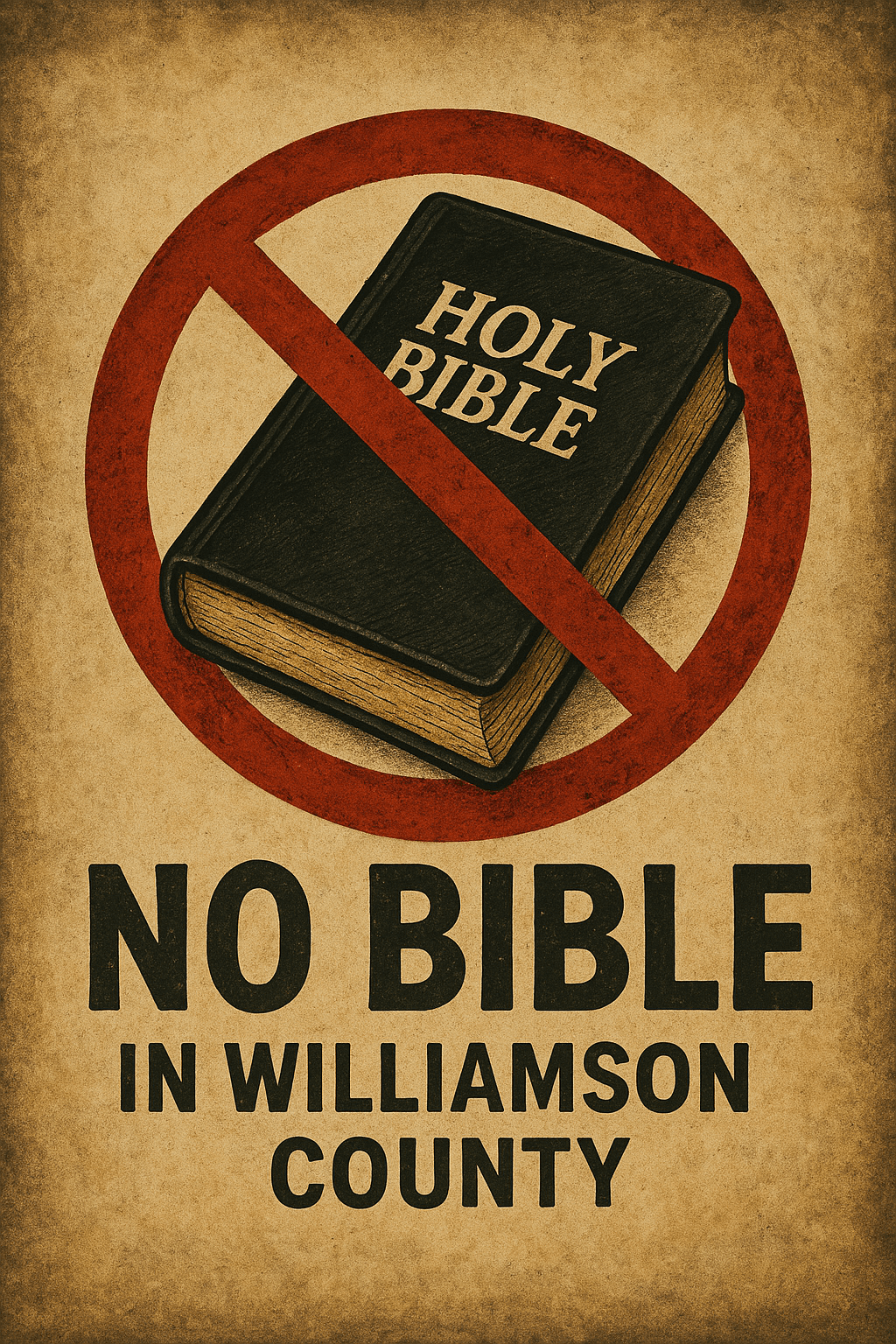
They Called It Contraband. I Called It Sacred.
I refused to surrender my religious materials. They called them contraband—I called them sacred. Prayer cloths, ritual texts, spiritual tools that tethered me to sanity inside a system designed to erase me. I knew the law. I knew my rights. But Williamson County Jail didn’t care.
Because I wouldn’t let them take those items, they strapped me into a restraint chair.
For over two and a half hours.
My hands turned purple.
Circulation cut off.
Pain radiating through my arms like fire under the skin.
They didn’t loosen the straps. They didn’t care. It wasn’t about safety—it was punishment. A ritual of humiliation for daring to protect what was sacred.
I’ve spent decades installing surveillance systems. I know what those smoke detector cameras saw. I know they recorded my hands swelling, my body trembling, my spirit refusing to break. And I know they’ll say the footage doesn’t exist. That it was never serious. That I was never in danger.
But I remember.
I remember the pressure.
I remember the silence.
I remember the cost of refusing to be erased.
This wasn’t just a restraint—it was spiritual desecration. And I turned it into testimony. Into curriculum. Into fire.
Let me know if you’d like this modularized for COERCION, formatted for a chapter heading, or adapted for public testimony. I can scaffold it however you need.
1. U.S. Constitution
- First Amendment (Free Exercise Clause): Protects the right to practice religion. Courts have held that denying inmates access to religious texts or items can violate this right.
- Fourteenth Amendment (Due Process & Equal Protection): If religious rights are arbitrarily denied, it can raise due process and equal protection issues.
2. Federal Statutes
- RLUIPA (Religious Land Use and Institutionalized Persons Act, 42 U.S.C. § 2000cc-1): Requires jails to avoid imposing a “substantial burden” on inmates’ religious exercise unless it is the least restrictive means to achieve a compelling government interest. Throwing away religious materials is almost always a violation.
- Civil Rights Act, 42 U.S.C. § 1983: Provides a cause of action to sue state officials for constitutional violations, including destruction of religious property.
3. Texas Law (since you were in Williamson County, TX)
- Texas Constitution, Article I, §6 & §8: Guarantees freedom of worship and conscience.
- Texas Religious Freedom Restoration Act (Tex. Civ. Prac. & Rem. Code ch. 110): Mirrors RLUIPA; government can’t substantially burden religious practice without a compelling reason, and even then must use the least restrictive means.
4. International Standards
- U.N. Mandela Rules (Rule 65 & 66): Require that prisoners be allowed to practice religion and possess religious books.
- International Covenant on Civil and Political Rights (ICCPR, Art. 18): Protects religious freedom even in detention.
- Convention Against Torture (CAT): When combined with solitary and coercion, destruction of religious materials can be part of psychological torture.
5. Case Law (examples)
- Cutter v. Wilkinson (544 U.S. 709, 2005) — Supreme Court upheld RLUIPA as protecting inmates’ religious rights.
- O’Lone v. Estate of Shabazz (482 U.S. 342, 1987) — Recognized limits, but still requires prisons to accommodate where reasonable.
- Multiple lower court rulings have found that destroying Bibles, Qur’ans, or other religious texts violates both the First Amendment and RLUIPA.
👉 In short: Throwing away religious materials is likely a violation of the First Amendment, RLUIPA, Texas Religious Freedom law, and international human rights standards. It also opens the door to a §1983 civil rights lawsuit.
 LeRoy Nellis