
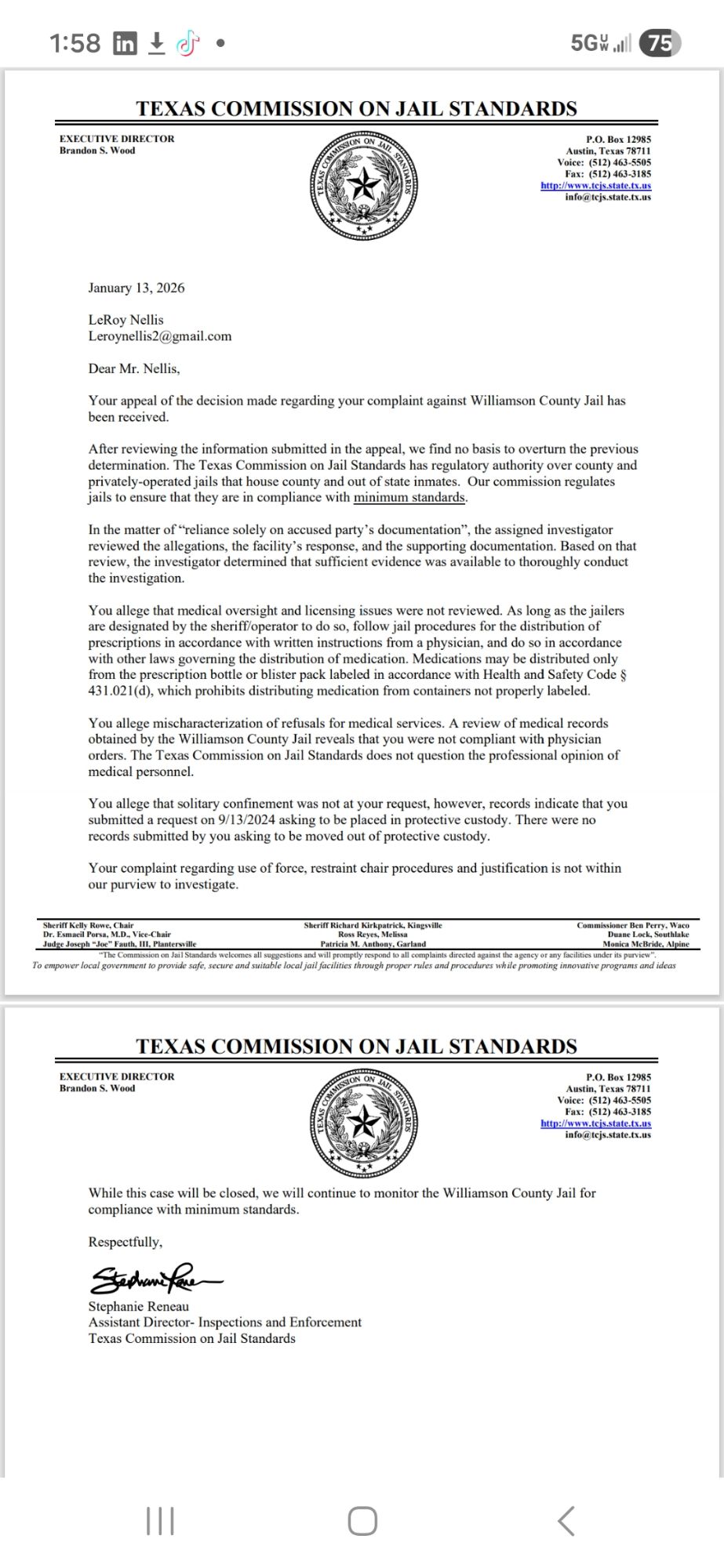
The Texas Commission on Jail Standards recently issued a final decision closing my complaint against the Texas Commission on Jail Standards. The Commission acknowledged receipt of my appeal, reviewed records supplied by the jail, and declined to reopen the case.
What matters most is not just what the Commission said — but what it did not.
According to its January 13, 2026 letter, the Commission relied on documentation provided by the jail itself. No independent inspection was conducted. I was not interviewed. No third-party verification occurred.
The Commission also stated that certain issues — including use of force and restraint chair practices — fall outside its jurisdiction. That distinction is important, because it clarifies where state oversight ends.
More significantly, entire categories of allegations were never addressed at all, including:
- Environmental conditions affecting sleep and physical health
- Structural vibration inside housing units
- Retaliation after complaints
- Interference with grievance processes
- Religious and communication-related issues
- Medical staff doesn’t have state licenses…. State Felonies.
The Commission closed the case while stating it would “continue to monitor” the facility. No factual findings were issued on these unresolved issues.
This is not an argument about guilt or innocence. It is a documentation of oversight limits.
When state regulators rely exclusively on jail-supplied records and decline jurisdiction over key issues, federal review becomes the appropriate next step.
Transparency matters. Oversight matters. And unresolved questions do not disappear simply because a file is closed.
Primary source: Texas Commission on Jail Standards letter dated January 13, 2026.
 LeRoy Nellis