
The True Story They Tried to Erase
By LeRoy Nellis
In 2019, over fifty armed officers from SWAT, the U.S. Marshals Service, and the FBI descended on my home in Round Rock, Texas.
Helicopters shook the roof. Snipers lined the cul-de-sac. The neighbors thought they were watching a terrorist takedown.
There was no conviction. No violence. No crime proven.
That raid marked the beginning of a six-year campaign of coordinated persecution — fueled by false accusations, political connections, and an ex-wife, a non-U.S. citizen, who learned to weaponize the Williamson County Sheriff’s Office as her personal enforcement arm.
Every charge, every “coincidental” re-arrest, every court delay was part of the same machinery — a county system built on dual-sovereign contracts, unlicensed medicine, and psychological warfare disguised as procedure.
THE MEDICINE OF MADNESS
Inside the Williamson County Jail, I learned what happens when medicine becomes an instrument of control.
Men in uniforms marked “EMS” and “Medic” injected substances without explanation.
When I demanded credentials, they laughed. They weren’t licensed EMTs. They were jail staff wearing fake EMT patches, posing as medical professionals in a facility with no full-time doctor and no 24-hour psychiatric coverage.
The man who claimed to be the supervising physician introduced himself as Dr. Alan Brooks — clipboard in hand, white coat, the confidence of authority.
He signed prescriptions, performed exams, and ordered injections.
But the Texas Medical Board had no record of him.
He wasn’t a doctor. He wasn’t licensed anywhere in the United States.
Yet Williamson County allowed him to diagnose, prescribe, and inject inmates for months.
On paper, the County’s “psychiatrist” was Dr. Ghulam M. Khan, listed on a Professional Services Agreement renewed through 2025.
His role was to prescribe psychotropic medication and oversee inmate mental health.
But like everything else in Williamson County, the truth was buried in the fine print:
Khan’s contract required only 16 to 20 hours of coverage per week — for over 600 inmates.
He rarely appeared in person, if ever.
When I finally saw him, the consultation lasted five minutes, and he never looked up from the paper.
My prescriptions bore his signature, yet he never once checked my vitals, reviewed labs, or confirmed a diagnosis.
Whether through neglect or deliberate fraud, psychiatric care in Williamson County was being practiced without medical oversight.
THE ECONOMY OF TORTURE
The rest of the week, the jail ran on unlicensed medics, correctional officers with EMS patches, and nurse practitioners making decisions far beyond their legal authority.
They injected diabetics with the wrong insulin, handed out psychotropics without follow-up, and delayed emergency transports until it was too late.
When inmates collapsed, it wasn’t an incident — it was an accepted expense.
I was strapped into a restraint chair for refusing to surrender a Bible, left under blinding lights for hours while they called it “policy.”
I spent 326 days in solitary confinement, light burning 24 hours a day, my nerves deteriorating until blindness crept into my right eye.
Every medical request I filed was marked unsubstantiated.
Every grievance disappeared into the bureaucratic abyss of “within policy.”
By the time I left, I was blind, disabled, and living proof that cruelty can be automated through paperwork.
THE SYSTEM BEHIND THE SCARS
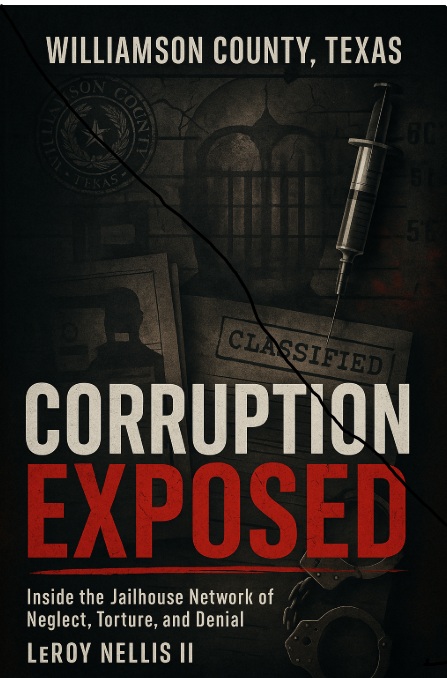
Williamson County, TX: Corruption Exposed documents, for the first time, how an entire county used unlicensed medicine, falsified titles, and intergovernmental contracts to turn its jail into a laboratory of neglect.
It reveals how the Texas Commission on Jail Standards, the County Attorney’s Office, and federal oversight agencies all looked the other way — because each was contractually insulated by dual-sovereign loopholes that made accountability vanish.
Behind every signature lies a human cost:
psychosis from wrong medication, seizures from withheld treatment, suicides mislabeled as “policy incidents.”
This isn’t mismanagement.
It’s a design of cruelty — written into budgets, hidden in contracts, and executed by people who were never qualified to hold a syringe.
“The law stops at the booking desk, and medicine becomes punishment.”
— LeRoy Nellis II
This is not a memoir for pity.
It’s an indictment.
A six-year exposé of corruption, cover-ups, and unlicensed medical practice in one of America’s wealthiest counties — a place where law enforcement turned medicine into torture and justice into theater.
If you’ve ever wondered how the United States created a domestic black site system without public awareness,
this is your proof.
This is the story they tried to bury — and the evidence they can’t erase.
 LeRoy Nellis